Various risks have come to the fore in 2026 against a backdrop of escalating geopolitical tensions, leading to an increasingly uncertain outlook for the global economy. Mitigating procurement risks has become an urgent management issue for the manufacturing industry in particular, and efforts to restructure supply chains -- with the aims of reducing regional dependence and diversifying suppliers -- are accelerating. On the other hand, technological innovation in the digital sector has been remarkable and, should the growing sophistication of generative AI and the shift toward autonomous AI continue to push digital transformation (DX), this innovation will likely become a driving force for new growth in the semiconductor industry.
As the person in charge of managing the SMIC Group, I am once again keenly aware of both the difficulty and the importance of staying on the right course in an era where risks and opportunities are so closely intertwined. To that end, I believe it is extremely important to view changing times as a given and, rather than trying to never make mistakes, we should seek to be a company that promptly acknowledges errors when they are identified, corrects our course, and possesses the fundamental strength to adapt to such changes in direction.
I am convinced that engaging sincerely with our stakeholders and building relationships of trust that allow us to quickly discern changes in the surrounding environment, while also establishing a solid foundation and a flexible organizational structure that enable us to adapt swiftly to those changes, will fuel the SMIC Group’s continued growth and help bring about sustainable societies.
Strengthening Our Organizational Structure to Enhance the Group's Overall Capabilities
In January 2026, Senju Metal Industry Co., Ltd., merged with its domestic Group companies Senju Electronic Corp. and Senju Giken Co., Ltd. through an absorption-type merger. I was personally involved in the founding of these two companies.
It all began about 30 years ago, when I was stationed in the United States. In response to requests from local customers, I recommended to the head office management that we expand into the semiconductor sector in addition to our existing assembly business. Solder balls were just then beginning to garner attention as materials that would support the miniaturization and increased functionality of semiconductor components, so we established both companies as startup ventures within the Group.
In line with the semiconductor market’s development and technological advancements, our Group has since expanded its product lineup to include not only solder balls and microballs but also such products as semiconductor flux and thermal interface material (TIM). The semiconductor-related business has now grown into one of our Group's key businesses. It was in light of these changes in the business environment that we carried out this merger to further integrate our business operations.
In another business restructuring effort, we have transitioned SMIC’s organizational makeup from a division-based structure to a headquarters-based one. While the divisional structure offers advantages such as rapid decision-making within each business unit and the ability to respond flexibly to market needs, it also posed the risk that prioritizing optimization at the business unit level could lead to a loss of focus on the direction of the company as a whole. Implementing swift policy shifts in a rapidly changing business environment mandates a structure in management policies be communicated accurately and promptly throughout the company and all employees can work toward a common goal. To this end, we decided to move to a headquarters-based system.
Going forward, the entire Group -- both domestically and internationally -- will work together as one to build a structure that enables us to achieve sustainable growth while maximizing each organization’s strengths.
Fulfilling Our Environmental Responsibilities and Striving to Realize Zero-emissions Societies
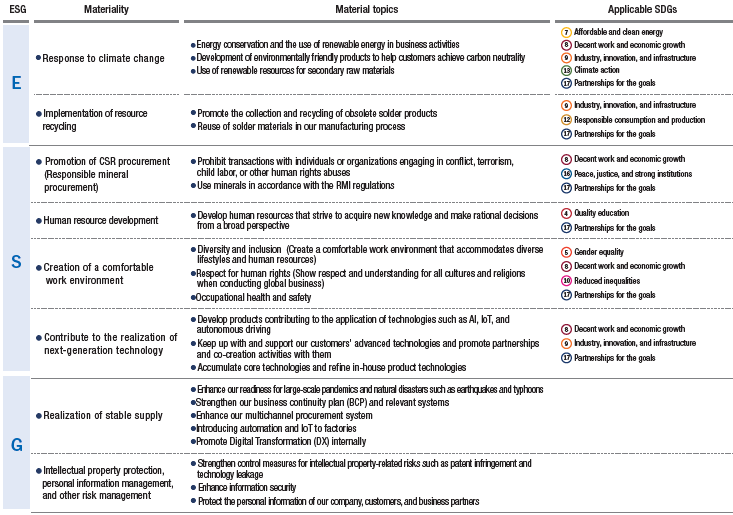
As a manufacturer that uses heavy metals as raw materials, the SMIC Group conducts business with proper consideration for local environments and earnestly reflects on the legacy we should leave behind for future generations. We believe that addressing global challenges such as climate change and resource depletion is a critical responsibility that we must fulfill as a company, and we consider it essential to step up our efforts toward reducing our environmental impact.
As part of these efforts, we have revised our Group’s greenhouse gas reduction targets and formulated a new medium-term plan to meet the international community’s shared goal of achieving carbon neutrality by 2050. We will wholeheartedly endeavor to reduce greenhouse gas emissions not only in Japan but also at our overseas locations, and we will accelerate our efforts to achieve carbon neutrality. While encouraging the use of solar power and other conventional renewable energy sources, we will also actively explore the viability of new approaches such as hydrogen energy and carbon dioxide capture and utilization technologies.
We plan to intensify our efforts to promote solder recycling as part of our circular economy initiatives by establishing an inhouse recycling system as well as by collaborating with our partner company TAK-G. We will roll out the recycling technologies and expertise that both our companies have cultivated over many years to our major manufacturing sites in Japan, and continue to build a more stable recycling system.
Building Sustainable Supply Chains Based on Trust
Tin is one of the most important raw materials for solder products. However, the tin ore used as raw material for tin metal is mined exclusively overseas, so procurement depends on imports from abroad. And, to put it bluntly, many of the areas where this tin ore is mined are low-income regions. From the very beginning of our solder business, we have made it a priority to ensure that those engaged on-site in this mining receive their compensation as quickly as possible. Accordingly, we have worked to make payments within a shorter timeframe than was customary in the industry at the time, even if it meant bearing a certain financial burden ourselves. I have heard that this stemmed from the desire of our company’s past leaders to show their appreciation to the locals whose dedication has made possible the stable supply of tin that is so important to our company.
I myself have visited several mining sites. In the course of interacting directly with the people working there, I became acutely aware that, for them, incomes supporting their livelihoods are more important than anything else. That experience further reinforced my belief that shortening pay periods -- a practice we have maintained to date -- is something SMIC should continue to do, and it became the driving force behind my ongoing efforts to explore further improvements ever since I assumed a management role. I am confident that we have now established a system that is optimal for both our suppliers and our company. As a follow-up to this story, when the supply of overseas materials became unstable amid the COVID-19 pandemic, the smelting companies from which we source tin ingots offered their full cooperation, enabling us to overcome those difficult circumstances. For me, too, this experience served as a reminder of the importance of the relationships of trust I have built over the years.
Both in procurement and beyond, we should consider what we need to do to understand others and build better relationships, and then act with sincerity. I believe that the trust built through these cumulative efforts will lead to sustainable growth not only for our company but for our entire supply chain. Rather than simply being my own personal opinion, I believe this idea represents “SMIC-ism” – that is, the vision of what SMIC should be – that I have inherited from the late Honorary Chairman Senju Sato and the late former Chairman Issaku Sato. I have faith that passing on this SMIC mindset to the next generation and evolving it in step with the changing times is a crucial responsibility I bear as the head of our management team.
Moving forward, the SMIC Group will continue striving to be worthy of the trust of all our stakeholders and to take on new challenges through our business activities that help produce sustainable societies.
Our Materiality